
Earliest Indian History in the Lafourche District (Terrebonne Parish area)
Land Sale Documents Providing Proof of Tribal Identity of Touh-la-bay, Toup-la-bay (same person), Alias Courteau or Houma Courteau as an Indian of the Biloxi Nation.
DOCUMENT 1
LAND SALE 29 August 1822
TERREBONNE PARISH, LOUISIANA
(OA Book A #51; COB 1 pg. 71)
JEAN BILLOT
TO
TOUH-LA-BAY ALIAS COURTEAU OF THE BELOXY NATION
Filed 19 May 1825
Be it remembered that on the twenty-ninth day of August in the forty seventh year of the independence of United States of America (Ao. Dni. 1822) before me Francis M. Guyol, judge for the parish of Terre-Bonne and ex-officio a notary Public in the same, personally appeared Jean Billot, a free man of coleur and resident of this Parish, of the first part and
Touh-la-bay alias Courteau of the Beloxy nation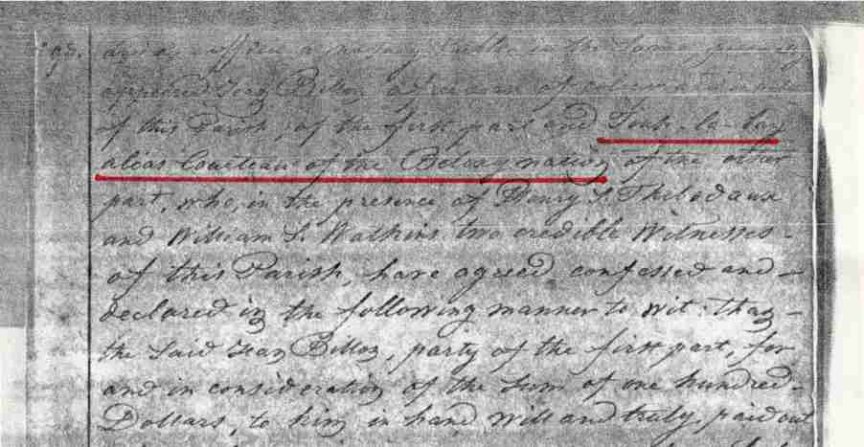 of the other part, who, in the presence of Henry S. Thibodaux and William S. Watkins two credible witnesses - of this Parish, have agreed, confessed and - declared in the following manner to wit: that the said Jean Billot, party of the first part, for and in consideration of the sum of one hundred dollars, to him in hand, well and truly paid out of our sight or view, the receipt
whereof he does hereby acknowledge and for ever discharge the said party of the second part, his heirs or assigns, hereby renouncing the exception and plea of non-numerata pecunia 1 has sold, transferred and made over, and by these presents does sell, transfer, and make over, to and unto the said party of the second part a certain tract of land, situate in the Parish aforesaid, and being five arpens on each side of said Bayou with such depth the grant calls for, and more or less however, bounded above by land of Alexandre Verdin and below by land of said Verdin. To have and to hold the said tract of land unto the said Touh-la-bay alias Courteau his heirs or assigns for ever; and the said party of the first part will warrant the same against all persons claiming under him.
of the other part, who, in the presence of Henry S. Thibodaux and William S. Watkins two credible witnesses - of this Parish, have agreed, confessed and - declared in the following manner to wit: that the said Jean Billot, party of the first part, for and in consideration of the sum of one hundred dollars, to him in hand, well and truly paid out of our sight or view, the receipt
whereof he does hereby acknowledge and for ever discharge the said party of the second part, his heirs or assigns, hereby renouncing the exception and plea of non-numerata pecunia 1 has sold, transferred and made over, and by these presents does sell, transfer, and make over, to and unto the said party of the second part a certain tract of land, situate in the Parish aforesaid, and being five arpens on each side of said Bayou with such depth the grant calls for, and more or less however, bounded above by land of Alexandre Verdin and below by land of said Verdin. To have and to hold the said tract of land unto the said Touh-la-bay alias Courteau his heirs or assigns for ever; and the said party of the first part will warrant the same against all persons claiming under him.
In testimony whereof the parties aforesaid have set their hands to the aforegoing on the date aforesaid -
Signed in presence of
H. S. Thibodaux
Jean (his x mark) Billot
Wm. L. Watkins
Tough-la-bay (his x mark) Courteau
Certified the above deed by me the judge aforesaid on the day aforesaid and under my hand and the seal of my office.
{Seal} Francis M. Guyol
Recorded this nineteenth of May one thousand eight hundred and twenty five.
Leufroy Barras
DOCUMENT 2 (Translated from document originally written in French)
LAND SALE 1 June 1829
TERREBONNE PARISH, LOUISIANA
(Book E, No. 837, pp. 108, 109. 3/526)
TOUP-LA-BAY, INDIAN OF THE BILOXI NATION
TO
ALEXANDRE VERDUN
The first day of the month of June, one thousand eight hundred and twenty-nine, before me, Leufroy Barras, judge and notary public in the Parish of Terrebonne, personally appeared
Toup-la-bay, said Indian Courteau of the Biloxi
nation,
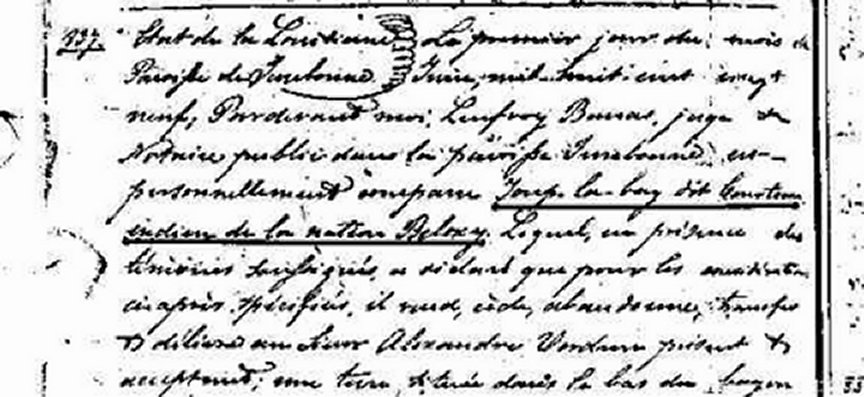 who in the presence of the undersigned witnesses declared that for the considerations hereinafter specified he sells, cedes, abandons, transfers and delivers to M(e?). Alexandre Verdun, present and accepting, a piece of land situated in the lower part of Bayou Terrebonne, containing five arpents front on each side of the aforesaid bayou with such depth as the certificate of confirmation calls for, bounded above and below by the land of the said Verdun, which land the vendor guarantees against all claims whatsoever unto the said Verdun to enjoy and dispose thereof in full ownership from this day forward and forever. This sale is made for the sum of three hundred and fifty dollars whereof one hundred dollars have been paid in cash, one hundred payable in one year from this day, and the fifty payable in course of the two aforesaid years as fast as the said Courteau (thick-set person) shall have need therefor. The aforesaid thick-set person (sic; courteau translated?) is owner of the aforesaid land by virtue of the acquistion that he made thereof from Jean Billiot, by act dated the twenty-ninth of August, 1822, which Billiot had had by concession thereof.
In faith whereof the appearers, after this was read, made their marks, not knowing how to write, in the presence of Messrs. Joseph Delaporte and Evariste Porche.
E. Porche
Toup-la-Bay, said Courteau (his x mark)
Joseph Delaporte
Alexandre Verdun (his x mark)
Leufroy Barras, P.J.
Recorded this 2d day of June, 1829
Leufroy Barras, Judge
Lafourche Heritage Society Seminar 4 Aug. 2001 presented by Mrs. Audrey B. Westerman CGRS
The Indians of Terrebonne and Lafourche Parishes
The Indians of Terrebonne and Lafourche Parishes are people from 5 tribes - Biloxi, Chitimacha, Choctaw, Acolapissa, and Attakapas, who came together here in the late 1790's. The majority of the core group were Chitimacha and have been here since before the arrival of the Europeans, or the first positive written contact in 1699.
Up until about the mid-1900's they referred to themselves in oral histories as "French Indians." Many of the elders said they were Chitimacha (Shitti-motch-kah; in one case an elder called them what was understood to be "Moscow" [Motch-koh] Indians), or what I call the "Eastern Band of Chitimacha"; the western band being those along Bayou Teche and in St. Mary Parish around Grand Lake.
Period of French exploration - 1699 Iberville & Bienville meet Biloxi, Chitimacha
Although earlier explorers referred to these Indians as "Yagni-chitto", which means "big land" they were probably referring more to the peoples of a land area and not the proper name of a tribe of Indians. It is known the Ouacha (Washa), Chawasha (Chouacha), and Chitimacha were inhabiting Bayou Lafourche before the arrival of Bienville and Iberville. Old maps show the Sitimacha at what we know as Cheniere Caminada, and Francois Xavier Martin stated in his History of Louisiana, "Iberville on ascending the Mississippi River saw it forked; one leading to the east, two to the west, called the fork of the Chitimachas." Bayou Lafourche was commonly known as the Fork of the Chitimachas, but one old map also listed Bayou Plaquemine (in Iberville Parish) as River of the Ouachas. This was the second fork of the Mississippi River on the west side and a curiosity because nothing has yet been found to prove the Ouachas were ever that far north.
Early on, the Chawasha Indians were on the west side of the Mississippi River at the site of settlement of the first Germans, but were displaced when the remnants of John Law’s settlers were placed on the First German coast. The Indians were moved to Belle Chasse, then as more settlers arrived, they were moved across the river into Plaquemines Parish below English Turn at Dalcour. They were there when Gov. Perrier armed black slaves, in the 1730's, and instructed them to destroy the Indian village in Plaquemines Parish. No further mention has been found of the Chawasha Indians.
Before 1732, the Ouacha had several villages along Bayou Lafourche, one near Supreme in Assumption Parish, one across Bayou Lafourche at Thibodaux, at Raceland, and at Lockport. All but the one at Supreme were on the eastern side of Bayou Lafourche. Today Ouacha village sites are being excavated in back of Gheens on Golden Ranch Plantation. A later record was the burial of D’argent Blanc, "Louis, of the Ouachas tribe, interred Dec. 12, 1772" from the St. Louis Cathedral. There is a Bayou Washa in Jefferson Parish, between Barataria and Cheniere Caminada according to the U.S. Census of 1880.
The Colapissa, who were on Pearl River in 1699, about 11 miles from its mouth, moved to Bayou Castine, in St. Tammany Parish, around 1702-1705, on the north shore of Lake Ponchartrain. Between 1718 and 1722, they moved to the Mississippi River and had a village at LaPlace, 35 miles above the New Orleans site; it is marked on the D’Anville map of 1732, but it was also taken over by early white settlers and the Colapissa went to Mobile. Pere Roquette, better known as "Chata Ima" (meaning like a Choctaw) said Colapissa meant "watch and see" and were sentinels of the Choctaw tribe. Le Page du Pratz wrote the Acolapissa were on "Choupic Creek" near Mobile, having sold their village to Pierre LaVigne before 1718, when Du Pratz arrived at that place. (Du Pratz also had a Chitimacha Indian slave, which he had bought in Mobile when he arrived from France.)
No mention has been found of the inner territory between Bayou Lafourche on its west side, and the east side of the Atchafalaya River (Lafourche and Terrebonne Parishes), other than the designation "Yagni-chitto." One map does show Lake Mechant, in lower Terrebonne Parish, as Lake Ouacha. This is near the known Indian villages on Bayou Chene, Bayou Mauvais Bois, Deer Island, and Bayou LaButte - all interconnected by small bayous through which they could pass to the Atchafalaya River.
French Colonial Period
Between 1702 and 1706 St. Denis and his men raided a Chitimacha village for women, called politely a "love raid" by some. There were few white women in the colony and this was done to provide wives, and slaves, for the Frenchmen. Historians disagree on exactly when this happened or where it happened. Some think it was the village at Donaldsonville and around 1706, but descriptions don’t prove that. Evidence of Chitimacha Indian females in slavery, listed by name and bearing children (the fathers Frenchmen), have been found in Natchez, Natchitoches, Illinois, old Biloxi, and Mobile, which pre-date the war on the Chitimacha from 1707 through 1718. Those in Natchitoches had the designation "de la Grand Terre" (of the big land), or "Yagni-chitto."
In Dec. 1706 St. Cosme, missionary to the Natchez Indians, while on his way to the Gulf Coast, was murdered along the Mississippi River, said to have been done by a Chitimacha hunting party, thought to be near Donaldsonville. In retaliation, in March 1707 Bienville declared war on the Chitimacha Nation. A raid was made on a Chitimacha village, place unknown. The raiding party consisted of 20 Bayougoulas, 15 Biloxi, 40 Chawashsa, 4 Natchitoches, and 7 Frenchmen. The Chawasha led the party to the village of the Chitimacha. "They surprised a village living close to a lake killing 15 and wounding 40 men, women and children. Many prisoners were brought back to Mobile with one of the murderers of St. Cosme." This is important to remember because Felicite Billiot said "Homa took Sitimasha to wait on [serve] them."
The oral history among the Indian elders of Terrebonne say their people were attacked at Pointe Barre in Terrebonne Parish, long before the arrival of resident white settlers; that the Chitimacha had gone there to trade with the French and were ambushed; the men and boys were killed, women and children taken as slaves. At first, this bit of oral history did not make much sense until the records and descriptions of the war, from several early historical sources, came to surface.
In 1718 peace was declared on terms of the French:
1. The Chitimacha would return all French prisoners.
2. The French would not have to give up the Chitimacha prisoners
3. The Chitimacha would sing the calumet in New Orleans before Bienville.
4. The Chitimacha would leave their place and live on a reservation one league from the camp of Mr. Paris (at Bayou Goula LA)
Although the Chitimacha were told to settle below Bayou Goula, they soon turned up in the area of Plaquemine above Bayou Goula ( in Iberville Parish between Bayou Jacob and Bayou Plaquemine and back to Grand River). Many historians have concluded these were all of the Chitimacha from the Mississippi River and Bayou Lafourche, but other historians report they had retreated to the "area of bayous and little lakes near the sea" which describes lower Terrebonne & Lafourche Parishes. And there they remained, unrecorded by history, until the arrival of the Acadians, in the Spanish period, in the latter 1790's, when missionary priests began to visit Bayou Terrebonne and written church records began. But the Acadians were not the first settlers of Terrebonne Parish. This is proven by Spanish land grants.
The Spanish Colonial Period
The Spanish government prohibited buying or selling Indian slaves and they encouraged owners to free them and set out instructions for freedom. Many "freedmen" began to appear in the Spanish census records beginning in 1770 and included the surname "Iris."
In 1787 a portion of land was granted to Marianne Iris on Bayou Terrebonne, the earliest date of record on land grants in Terrebonne Parish. Her land was below Point Barre, far down Bayou Terrebonne. Just below her was the grant to Jean Baptiste Billiot, in 1788, and below him was the grant to Manuel Albarado. Both the French and Spanish governments placed Indians and military men on the lower ends of the bayous to serve as a buffer against invasion by sea. Manuel Albarado was a Spanish soldier and the last habitation on the bayou, far below Montegut. The 1810 census of Bayou Terrebonne did not list Manuel Albarado, but gave Courto, an Indian, as the last resident but no land ownership was shown for him. The census did state that he paid taxes and had 6 children in his house.
Although a proper marriage record has not been found for Marianne Iris and Jean Baptiste Billiot, other documents have been found that prove they lived together and had children, including his will, made in New Orleans in 1784, where he named her as his heir. She has been referred to in various records as a "free woman of color" and one record called her a "negresse" - causing much confusion about her racial identity. Her children and later generations of descendants have been called Indian, free people of color, mulatto, and sometimes white. Jean’s will (made by him and filed in New Orleans) called her a griffe (tri-racial person), and the baptism of one of their children "Rosalie Francoise, a free quadroon" called Marianne, her mother, a "free griffe". Further investigation revealed her Indian ancestry and griffe to be correct. Oral history says she was Chitimacha.
We assume Jean Baptiste was a widower when he obtained his grant on Bayou Terrebonne. He had been married in 1764 to Marianne Elizabeth Durand, a native of Martinique, and they had five known children, baptized in New Orleans.
In 1794 after three hurricanes in succession, much of the Felicianas were destroyed. The Acadians at Bayou des Ecors in the Felicianas, who had arrived from France in 1785, were allowed by the Spanish Governor to come to the bayou country because their crops had been destroyed for three years in succession and they were being harassed by neighboring Indians who stole their livestock.
First Indian family names of modern date
The Billiots (of Chitimacha ancestry) and Courteaus (of Biloxi and Colapissa ancestry) are the founding families of the Indians of modern date in Terrebonne and Lafourche Parishes. Two half-sisters, Genevieve Magneau (Mayon) and Manette Lucie Renaud, whose mother was an Acadian, married into the Billiot clan. In fact, Manette married (1) Michel Billiot around 1822, (2) Jean Charles Billiot who died around 1839/1840, then she married (3) Etienne Billiot in 1843 - all brothers. Of the 10 children of Jean Baptiste Billiot and Marianne Iris, marriage or baptism records reveal new names - Dion/Jeanne, Mingoloi, Courteau (Jeanet and Pierre - NOT children of Houma Courteau), Gregoire, Dardart, Crepelle, Jaco, Verdun, Frederic, and Saulet. Of these ten names, five definitely have Indian origins. Another name that appears today in the Indian community is Foret but it is not of the Acadian Foret’s. It is a shortened version of La Foret, a translator of the Indians, whose wife was Indian.
Around 1818, Alexandre Verdun moved from St. Mary Parish to Bayou Terrebonne with his Indian wife and their children, who, through intermarriage, brought into the Indian community the Verret, Lovell, Naquin - Dupre - and Trahan (of Acadian origin) as new surnames.
Until the middle of the 1900's and desegregation these names identified the people as Indian and kept them isolated in small Indian communities on the lower bayous.
Louisiana Purchase 1803 -
In 1808 Courtien (sauvage) and Jacques (sauvage) had land on Bayou Lafourche near Gheens which authorities sold for unpaid taxes; a Marie Rosalie was a near neighbor. They were listed as "absent land owners" at the tax sale. (Felicite Billiot d/o Jacques Billiot & Rosalie Courteau said Houma Couteau/Courteau was born and raised at Biloxi, went to the Mississippi River, then to Tuckapaw canal, then to Lafourche.) In two land sales, the first from Jean Billiot in 1822, the second to Alexandre Verdin in 1829, Houma Couteau said he was an Indian of the Beloxy Nation. His wife was Marie Pierre, named in the late adult baptism of Rosalie Courteau and clearly written. Her brother was Louis, sauvage, who had a land grant on Bayou Terrebonne which went to Marie Pierre upon his death as his only heir. According to oral history they were of the Colapissa tribe.
Felicite also told John R. Swanton, anthropologist, the "Old Houma woman" (Rosalie Courteau) was contemptuous of the Chitimacha. She said Benjamin Paul (Chief of the Chitimacha at Charenton) used to come to Terrebonne to teach the people the language.
Territorial Period 1803-1812, proving land claims (names on Bayou Terrebonne)
No Spanish land grant claims were recorded on Bayou Pointe-aux-Chien, Isle Jean Charles, or Bayou Little Caillou. In the 1830's Congress began selling "public lands" on Bayou Little Caillou and is the first documented record of ownership of land by the Indians.
1810 - first public mention of Courteau in Terrebonne Parish, in a note for money owed to Solomon Lamb, and on the census of Lafourche Interior Parish.
Battle of New Orleans, Dec. 1814-Mar. 1815.
Jean Lafitte said the Indians served and were "paid well." Indians were used as boatmen to transport troops across the Mississippi River but no records of service have been found. Rosalie Courteau filed for widow’s pension on the service of Jacques Billiot but it was denied because there was no service record.
~~~~~~~~~~~~~~~~~~~~~~~~~~~
1850 census, Alexandre Verdin living at Bayou Chene.
1850 Pointe-aux-Chien first listed in records, Alexandre Billiot "Chief of the Chitimachas" and Celestin Billiot first listed there (sons of Jacques Billiot and Rosalie Courteau)
1870's Land on Isle Jean Charles bought from State of Louisiana
By the 1880's Indians were moving west from Bayou Little Caillou through Bayou Sale to Dulac and Grand Caillou; and Indian settlements at Bayou Mauvais Bois, Bayou LaButte, Felix Bayou became known.
1909, 1915, 1926 Hurricanes.
1909 caused many Indians to move from PAC to Fala, L’Esquine, Perriaque and Bayou Lafourche below Golden Meadow. Most of them had lost everything except the clothes on their backs.
1915 over 300 people drowned below Montegut - 4 can be identified as white, none of the others have been identified and are assumed to be Indians. The Indian settlement was about 10 miles below Montegut, called by the Indians - Taire-bonne - is now in swamp and can only be reached by boat. This hurricane caused the survivors to move to higher ground.
1926 there was severe flooding from a hurricane and caused deaths.
The Choctaw and Attakapas Connection
Barthelemy Billiot (b. around 1834) told Swanton in 1907 that his grandfather was Shulu-shumon (Shulus-humon = red shoe or war chief) from Biloxi, who was a chief, was run out by the Indians and made a medal chief by the white people, and his (grand?) mother was an Attakapas from "Texas." His people were called "Homma." There is record of Shulu-Shumon (war chief in the Choctaw Nation from Couechitta) who wanted to remain neutral in the French and English war and trade with both factions, who was killed by his own people in 1747. He had been made a medal chief by the English and, at the instigation of the French, his people killed him. After his murder, his followers fled to Biloxi. The Choctaw were also called "houma" "homa" "humon" meaning "red". In the early period "Texas" include the area below the Red River and west of Bayou Teche (the country of the Attakapas Indians). Barthelemy also said the Chitimacha and Homma came together here (Terrebonne Parish).
The words "abbe" and "ubbe" mean killer in Choctaw and is the common ending of many Choctaw names. Felicite Billiot (b. Around 1828) told Swanton her grandfather was Joseph Abbe but was always called "Couteau" (meaning knife). The Acolapisas were the tribe of her grandmother. Felicite knew both of her grandparents. They died when she was around 16 or 17 years old, and she was in her 50's when her mother, Rosalie Courteau died - therefore she is the most important witness to the origins of her family, speaking from personal knowledge.
A Cultural History of Lafourche Parish
[The Chitimacha Indians]
Research Paper Prepared for Regional Science Fair
Nicholls State College
1965By Terry Galliano
Acknowledgments
For any project to be successful, a great deal of work has to be employed. Professional people had to be called in to verify the findings of the excavations. The author wishes to thank all those who have contributed to make this research project one that will be of great use to future students of history in our area. The following are those who have provided help in some capacity to the author.
Dr. Joy Jackson, Nicholls State Social Science Department
Professor Henry Dufour, Nicholls State Social Science Department
Professor Otis Hebert, Nicholls State Social Science Department
Professor F. Max Hardberger, Nicholls State Biological Science Department
Dr. William Haag, Louisiana State University Social Science Department
Dr. Fred B. Kniffen, Louisiana State University Social Science Department
Mr. Elton Plaisance, Senior at Nicholls State majoring in Social Science
Mr. & Mrs. Emile Stouff, residents at Charenton, Louisiana. Mr. Stouff is the head of the Council
Mr. J. J. Mixon, Principal, Charenton Elementary School
Master Raleigh "Doodle" Marcotte, guide to Charenton
~~~~~~~~~~~~~~~~~~~~~~~~~~~~~~~~~
Our first picture of the Indians of Lafourche Parish must be gleaned from the accounts of the early French and Spanish explorers of the sixteenth, seventeenth, and eighteenth centuries. They include such men as La Salle, Iberville, Bienville, and others. Within the last eighty years or so professional ethnologists have entered the field, but unfortunately the survivors of the Louisiana Indians of Lafourche Parish are very few, and they have retained little of their ancient customs.
In this paper the attempt is made to present Lafourche Parish as a part of the scene in Louisiana at the approximate time the Indians were making their first contacts with the early European explorers at about the year 1700. Very little is known about the Indians before this time, because no written accounts were made.
The tribes of the Chitimachan stock were orientated about Bayou Teche and Grand Lake, and at several points along Bayou Lafourche. The Chitimacha proper occupied two groups or villages, those on the lower Bayou Teche and about Grand Lake, and along upper Bayou Lafourche. The Washa and Chawasha, two apparently independently Chitimacha-speaking tribes, originally had their villages on lower Bayou Lafourche. The section occupied by the Chitimacha is notable of its complex network of waterways and its abundant provision of fish and shellfish. Extensive accumulations of clam shells indicate an important source of food to supplement other products.
Bayou Lafourche was so heavily inhabited by these Indians that Martin recorded "Iberville on ascending the Mississippi River saw it forked; one leading to the east, two to the west, called the fork of the Chitimachas."
The name, Chitimacha, comes from, as Gatschet stated, the Indian word, Tcu’ti-ima’ca, "those having cooking vessels," or from Ce’ti, their name for Grand River. Today they name themselves Pante pinanka’nc, "men altogether red," which they adopted when the white men came. Their name appears as one of the four tribes living west of the Mississippi River.
The French hesitated to reach the Chitimacha villages because of a former hostile reception at the hands of the Washa. The Chitimacha came to be known during 1706, in La Harpe, Journal of History, August 1706. He recorded that the Taensa, having massacred the Bayogoula, invited the Chitimacha and Yaguénéchiton nations to come and "eat the corn of the Bayogoulas." On entering the Taensa village, many were captured and made slaves. That same year a war party of Chitimacha, who were said to have been disappointed in an attempt against the Bayougoula, discovered St. Cosme, missionary to the Natchez, and three other Frenchmen encamped on the bank of the Mississippi River and killed them all. There is another story as to how St. Cosme was killed. It is stated that St. Cosme on returning from one of his missions was tired and saw an Indian encamped on the bank of the Mississippi River. He asked the Indian to sleep overnight in his tent. The Indian agreed but later killed him while he was asleep. Anyway, M. Berguier brought the news of this to Biloxi on January first (1707). He learned of it by a slave of St. Cosme who had escaped. Bienville quickly sent gifts to the nations along the lower Mississippi to induce them to war with the Chitimacha. In March 1707, twenty Bayogoulas, fifteen Biloxi, forty Chawasha, four Natchitoches, and seven Frenchmen left for the Chitimacha country. The Chawasha guided them. They surprised a village close to a lake killing fifteen and wounding forty men, women, and children. Many prisoners were brought back to Mobile with one of the murderers of St. Cosme. He was beaten to death, scalped, and thrown into the sea. There is another story about the fate of one of the murderers which will be stated later in the story of the peace treaty.
Penicaut said that St. Denis made an expedition against the Chitimacha in 1705 with fifteen French and eighty Acolapissa and Natchitoches Indians. "They ascended Bayou Lafourche, ‘the river of the Chitimacha,’ as it was called, but on the way fell in with a party of Chitimacha of whom they took twenty women and children prisoners. The rest escaped, however, and carried the alarm to their village, rendering it necessary for the expedition to return without proceeding farther." Because of Penicaut’s confused chronology the writer thinks that the statement applies to an event five years earlier than the Chitimacha war.
Although no other attack by Frenchmen on the Chitimacha was recorded, they were constantly harassed by Indians allied with the French. In fact so harassed that they moved to the most inaccessible region near the sea, a network of bayous. On account of this long drawn out war most of the Indian slaves were Chitimacha. In 1718, Chitimacha Indians annoyed settlers so much that Bienville decided to make peace. It is related by Penicaut.
Penicaut, as he wrote, was sent by Bienville to propose peace with the Chitimacha Indians. He planned to go to a village of Oumas near that of the Chitimacha. A few Chitimacha Indians were there once in a while and he wanted to talk to them before actually going to the chief. He asked them to bring the chief near M. Paris’s camp which was near the camp of the Oumas to talk peace. The Indians agreed happily and after ten days they came with the chief. The chief was glad to make peace. The provisions of the treaty were as follows:
1. The Chitimacha would return all French prisoners.
2. The French would not have to give up the Chitimacha prisoners.
3. The Chitimacha would sing the calumet in New Orleans before Bienville.
4. The Chitimacha would leave their place and live on a reservation one league from the camp of M. Paris.
The Chitimacha agreed and prepared to meet Bienville at New Orleans in 1718. The ceremony was recorded by Du Pratz.
He states that the Chitimacha were forced to request peace because they had lost most of their warriors. The governor granted it to them on the condition that they bring the head of the murderer of St. Cosme. They accepted this and came to sing the peace calumet to M. De Bienville. They arrived by the river in many pirogues singing the peace calumet. They swung the calumet over their heads and shaked rattles in cadence to the song. It took them almost half an hour to travel one hundred paces to the governor, dancing and marching in cadence to the song. They stopped after they had reached the governor. They sat on the ground to catch their breath and the "word-bearer," to collect himself before delivering his speech. Then, after a while passed in silence, the word-bearer rose with two others of which one filled the pipe of the calumet with tobacco, and the other made the fire. The word-bearer smoked the pipe then handed it to Bienville who smoked it also. Then all the high officials repeated the act. The calumet was given to Bienville. The two assistants left the word-bearer standing alone, who presented a present to the governor of untanned skins. He then wrapped himself in a robe of deer skins and began the speech:
"My heart laughs with joy at seeing myself before you. We have all heard the word of peace which you have sent us; the heart of all our nation laughs with joy even to trembling; the women, forgetting on the instant all that is past, have danced; the children have jumped, like young deer, and run about as if they had lost their senses. Your word will never be lost; our hearts and our ears are filled with it, and our descendants will preserve it as long as the ancient word shall endure. As the war has made us poor, we have been compelled to hunt, in order to bring you the peltries, and prepare the skins before coming; but our men did not dare to go far on the chase, on account of the other nations, for fear lest they had not yet heard your word, and because they are jealous of us. We ourselves even have only followed our course in coming hither with trembling until we have seen your face.
"How satisfied are my heart and my eyes to see you now, to speak myself to yourself, without fear that the wind carry off our words on the way!
"Our presents are small, but our hearts are large to obey your word. When you speak you will see our legs run and leap like those of stags, to do what you wish."
Here the orator or word-bearer struck an attitude; then raising his voice, he began again with gravity:
"Ah! How beautiful is this sun now in comparison with what it was when you were angry with us! How dangerous is a bad man! You know that one single person killed the Frenchman, whose death has made fall with him our best warriors; there remains to us only old men, and children; you have demanded the head of the bad man, in order to make peace; we have sent it to you, and there is the only old warrior who has dated to attack him and kill him. Be not surprised at it; he has always been a true man and a true warrior; he is a relation of our sovereign, and his heart wept day and night because his wife and child are no more since this war; but he is satisfied and I also now, because he has killed your enemy and his. Formerly the sun was red, the roads filled with brambles and thorns, the clouds were black, the water was troubled and stained with our blood, our women wept unceasingly, our children cried with fright, the game fled far from us, our houses were abandoned, and our fields cultivated, we all have empty bellies and our bones are visible.
"Now the sun is warm and brilliant, the heaven is clear, there are no more clouds, the roads are clean and pleasant, the water is so clear that we can see ourselves within it, the game comes back, our women dance until they forget to eat, our children leap like young fauns, the heart of the entire nation laughs with joy, to see that we will walk along the same road as you all, Frenchmen; the same sun will illuminate us; we will have but one word, our hearts will make but one, we will eat together like brothers; will that not be good, what say you?"
After this the ceremony was ended by Bienville.
To the above opinion there is little doubt that this is correct; only that M. De Pailloux, Lt. Governor, and how Bienville presided at the ceremony and the other story of the fate of the killer of St. Cosme disagrees. The speech shows that the Chitimacha Indians hated the war and were greatly reduced by it. It also shows the wisdom of the word-bearer.
The Chitimachas moved to the reservation in 1719. There is the question about whether the tribe that settled there were all of the Chitimachas existing, and also if really all the tribes of the Chitimachas actually participated in the war with the French, after all. When we first get a clear view of the whole Chitimacha territory we find them divided into two sections, one living on the Mississippi or the upper part of Bayou Lafourche, the other on Bayou Teche and Grand Lake. We think that the division was caused by the Mississippi River flood. Chitimacha Indians, however, say that they lived there always. It is thought the word Yagnatcito is applied to Chitimacha Indians on the Bayou Teche.
In 1722, Charlevoix seems to have missed the Chitimachas. He stated, "the nation of the Chitimacha is almost entirely destroyed; the few that remain are slaves in the colony." In 1727, Poisson found them moved above their point of placement. Probably because of the river flood. Their chief was named Framboise. De Nouaille, in 1739, saw them below the reservation.
In 1784, a village of twenty-seven Chitimachas was found on Bayou Lafourche and two on Bayou Teche. One of the latter was under Fire Chief or in Mobilian, Mingo Luak, and was ten leagues from the sea, the other was under Red Shoes, and was a league and a half higher. There were mentioned by many writers, but were surely not the only Chitimacha villages during this time. Lafourche’s band probably settled later at Plaquemine. One survivor is know to remain there, a girl. The descendants of the Bayou Teche band are in Charenton with about sixty Indians.
In June 1767, the tribe was officially recognized by Spanish and French governors of Louisiana and its territorial integrity guaranteed. Governor W. Aubry passed an Act recognizing the Chitimachas and ordered the commandant at Manchac to treat the Chitimacha chief with respect. In 1777, Governor Galvez, at New Orleans, made an Act commanding all commandants and subjects of Spain to respect the rights of the Indians and their land and to protect their possession of their land. This information is stated in Docket No. 12585 of the United States Circuit Court at New Orleans.
Gatschet, in his paper of 1883, enumerated fifteen tribes, all of them but two of which he got by the information of the Chitimacha tribe themselves. The following are thirteen from the native sources, with such additions and corrections as the writer [Swanton] was able to make through the information furnished by Benjamin Paul, now looked up to as a chief by the remnants of the Chitimacha tribe.
(1) Tch_t Kasitunshki, now Charenton, on Bayou Teche, and on the southwest side of Grand Lake
(2) Amátpan nánu, Bayou Gris, three miles east of Charenton, on Bayou Teche [on the lake shore]. The writer [Swanton] was told that this was probably correct, but that there was a better known village of this name on the side of Grand Lake opposite Charenton.
(3) Ne Pinu’ne "Red Earth." Gatschet gives "net pinu’sch" which words mean "red tobacco," two miles west of Charenton (on Bayou Teche).
(4) Co’ktangi ha’ne het ci’ne, "Pond-lily worship house," on the south side of Graine ‘a Vol’ce inlet, Grand Lake, three or four miles northwest of Charenton in a low, swampy tract of land said to be occupied by the plantation of Mr. Rodrigue. There was an Indian cemetery there and Gatschet states that it was the site of their central house for religious dances, but the writer [Swanton] was informed that each town had a separate dance house.
(5) Ne’kun tsi’suis "Round island," a town opposite Ille aux Oiseaux, in the Lac de la Fausse Pointe.
(6) Hi’pinimte na’mu "Prairie-landing village," on the western part of Grand Lake, at the Fausse Pointe, near Bayou Gosselin. Another place so named is said to have been on Lac d’Autre Rive, between Charenton and St. Martinsville.
(7) Na’mu ka’tsi (Gatschet has Nu’mu Ka’tsuya, which is said to be erroneous; ka’tsi signifies bones, or as in this case, the framework of the houses, the frames having stood after the houses were abandoned), Bayou Chene village, St. Martin’s parish.
(8) Ku’cux na’mu "Cottonwood village," on Mingaluak, near Bayou Chene.
(9) Ka’me nake te_t na’mu, at Bayou du Plomb, a large Indian town, near Bayou Chene, eighteen miles north of Charenton.
(10) Tsa’xtsincup na’mu, on Bayou des Plaquemines, near Grand River, forty-two miles north of Charenton, the Plaquemine village.
(11) Grosse Tete na’mu (Indian name not remembered), two miles from the Plaquemine village.
(12) Ce’ti’na’mu, west of Plaquemine, on Grand River, the name of which was Ce’ti (Gatschet gives Gce’ti), twenty miles east of Charenton.
(13) Gea’ti Kute’ngi na’mu at the junction of Bayou Teche and Bayou Atchafalaya.
The two remaining villages given by Gatschet are thought by him to be on the site of Donaldsonville, at the upper end of Bayou Lafourche. This can not be because this is the place assumed where St. Cosme was killed and all accounts of the event prove the killing to have been done far from the Chitimacha village.
Another he cites at the mouth of the bayou. This city is also unauthenticated by no evidence on Gatschet’s part. The writer has named a few villages not mentioned by Gatschet.
(1) Catnic [C_tenic] "Em(p)ty Place" because the site was not occupied until after the civil war, near Baldwin, at Jeanerette.
(2) at "Bitlarouges" (?)
(3) at the shell bank on the shore of Grand lake close to Charenton.
(4) At a place called Okû’nkîskin "Deep Shoulder," probably named so because the bayou turns there like a man’s shoulder.
(5) At Irish Bend near Franklin (Wai’t’inîme), "Wait’l landing place," which was very large.
The Chitimacha Indians ranked third in Louisiana Indian grouping. The total population averaged 3,000 including the Washa and Chawasha tribes which are classed as Chitimacha Indians. Their population today (1907) is about sixty. They live in Charenton, Louisiana on a Federal reservation.
These Indians lived on Middens. A midden is an island or hill above marsh and water. It is formed by white clam shells which were eaten by the Indians. On these middens were their homes. Their homes were usually built of wood, canes, or reeds which were thatched with grass, moss, palmetto leaves, or corn husks. They were usually round, about thirteen feet high, and had small doors, but no windows. A large hole in the top of the door let out the smoke from the cooking, mosquito, or heating fires and let in a little light.
The Chitimachas knew something about the Taensa language. From the Chitimachas at Charenton, Swanton, while working for the Bureau of American Ethnology, learned that the father of the oldest woman of that tribe was a Taensa, and that she herself had formerly been able to use the language. A few days after receiving this intelligence he called upon this woman and tried in every way to stimulate her memory into remembering at least one word, but in vain. All that he could learn was that Ki’pi, which signifies meat in Chitimacha had another meaning in Taensa, but what it was she could not say. This is indefinite enough, but perhaps it may have really been the Natchez infinitive ending, -kip, -kipi, -kup, -kupi, which is employed very frequently, and consequently may have retained a place in the memory after everything else had gone. At any rate ki’pi is a combination of sound not conspicuous, if indeed it is existent, in Parisot’s Taensa Grammar.
The Chitimacha were distinguished from the rest of the Lower Mississippi River Tribes principally by the increased importance of food from land animals. In the Aboriginal state, the tribe supported themselves on vegetables mainly. However, they hunted other food also. The women collected pistaches, wild beans, a plant called ku’panu, woman’s potatoes, seed of pond lily, grains of palmetto, rhizome of common Sagittaria, persimmons and other wild plants. They planted maize (corn), sweet potatoes, squash, pumpkins and other crops. Three kinds of native corn are remembered. There was the white corn, commonly called "flint corn," the second was the yellowish corn, probably a variety of the first, the third was blue or black and was found when the Indians came here. All were easy to grow. There is said to be another kind of which the finest flour was made. Ha’sutopa was probably made from this corn. It was made by parching the corn, grinding it fine, and removing the hulls with a flat basketlike sifter. However, the Indians lost the seeds of these corns and now plant modern corn.
The Chitimacha Indians were good hunters. They also fished well. Gatschet stated that these Indians did not use nets to fish but they did. They made two kinds. One was a net of vines (rabbit vines) strung over round frames and placed at the mouths of bayous, the other was a sort of trap used the world over. It was made of slats and had a funnel shape. It had entrance of about four feet in diameter and sometimes even larger. Bears were killed in dead falls, and smaller game by blowguns made of cane hollowed out. The arrows of the blowguns were made of slender pieces of cane feathered with thistledown.
Like most of the Indians of Louisiana, the Chitimacha had storehouses for their food. They stored corn, beans, sweet potatoes, squashes, pumpkins, and other food crops in them. They were built on four large posts, about twelve to fifteen feet high, and polished so that mice could not climb up, and in this way protect their corn and squashes.
Before they learned to make pottery, the Chitimacha used to cook by "stone boiling." They put water in deerskins which were stretched over sticks to form a pocket. Water was put in the pouch and a fire kept blazing along side of it. The hot rocks from the fire were put in the pouch successively, getting the water hotter and hotter until boiling. Then the food was put in to cook. When they learned to make pottery, the Chitimacha Indians cooked over an open fire. Many various dishes were developed. The hasutopa is explained above. Hominy was made by soaking corn in water containing wood ashes and then cooking it. Fresh, salted, dried, or smoked meats were boiled or roasted. Fruits were dried and used in a variety of ways, such as with meats or vegetables, or in breads. Meals and flours were made from corn, beans, various tubers and nuts grounded with large wooden mortars and pestles. Grains were parched, cooked, or dried. Perhaps the most common Indian dish was the famed sagamite, a sort of porridge made of corn and beans, to which meats, nuts, and fruits were sometimes added. Bread was usually cooked by wrapping small loaves or cakes in corn shucks and baking them in hot ashes or in depressions hollowed out under the cooking fires. Because they did not like to mix the flavors of meat and vegetables in cooking, they cooked them in separate pots.
Like most Indians, the Chitimacha Indians like to wear ornaments and to dress up in their own special way. Ancient garments are not remembered, but Gatschet learned that these Indians were very peculiar in their decorating. The men had long hair with a piece of lead or stone tied on the ends of each strand to keep them erect. They adorned themselves with care and artistic taste. Their legs, arms, faces, and bodies were tattooed with wavy punctured lines. They wore many necklaces, finger-rings, bracelets, nose-rings and ear-rings. Many of the beads were made of shell, but some were of stone from the northwest Indians. Pieces of copper hammered into bracelets, shoulder pieces and breast pieces were common. The chief had a piece of copper on his head. However, Davis, in his book states otherwise. He states that the men sometimes shaved the head at the sides and in front, leaving only a single ridge of hair extending from the middle of the head to the back of the neck, cut to a length of two or three inches, tied with strips of deerskin, and ornamented with colored feathers. Men did not wear beards and generally removed the hair from their faces, as Penicaut described the process, with "shell ash and hot water as one would remove the hair from a suckling pig." The warriors had a special distinction from the other men. Their knees were painted by appointed men. They scratched the skin with a jaw of a small garfish until it bled slightly. Then, they put pulverized charcoal on them to give the knees a grayish color. This was repeated every year.
The women wore their hair in plaits and tresses ornamented with plumes. Part of the hair was coiled about the head and held by pins. They also wore bracelets, ear-rings, and finger-rings. They painted themselves only with red and white colors. Again, Davis adds that some women wore their hair like the men with shaved heads.
Some of the ornaments worn by the Indians are mentioned above. However, they wore many more. They wore no hats but many various metal disks, breastplates and ribbon-like decorations. The higher ranked Indians wore necklaces of pearls or other semi-precious stones. They wore leather or fiber-platted belts and fancy mulberry cloth or feather capes. Festivals were the times for dressing at their best. The early French visitors who witnessed these events usually wrote extravagantly of the elaborate customs.
Both men and women painted their faces and exposed portions of their bodies on many occasions. Painting men for the warpath was an intricate business frequently calling for the skill of a semiprofessional painter. Both sexes painted for social and religious occasions and liberally daubed their faces and bodies with blues, greens, yellows, and reds, which were favorite colors. One of the most commonly used designs was that of a half-moon in bright yellow on each cheek.
Indian life was simple and centered around the family. Education for boys and girls was designed to prepare them for their duties in providing for a family when they reached adulthood; in addition, the boys were taught the arts of war. Both boys and girls were trained in physical fitness, and some of the exercises were so strenuous that the weaker ones died.
Beginning at the age of four or five, boys and girls were given regular training in running, tree climbing, swimming, jumping, and wrestling, and these fundamental exercises were continued until the age of fourteen or sixteen. During the adolescent years, boys were taught to cultivate grain or garden crops, fish, hunt, and fight, and the girls to cook, prepare skins, sew, grind grains, select edible wild grains, nuts, roots, fruits, berries, herbs, and shoots, and to do decorative work.
The old men and women of a village had general charge of the education and they were hard taskmasters. Shaming and appeals to pride were used rather than whippings, though boys who could not get along with their fellows were sometimes exiled and/or shut up in the temples for varying periods. All children were taught courtesy and politeness to all persons and respect for their elders. The importance of personal honor, honesty, forbearance, and stoicism were instilled in early youth, and in these qualities, the Louisiana Indians of the Chitimacha tribe will have to be placed above the white settlers who crowded him from his land. However, it is stated by Swanton that the Chitimacha and other coastal tribes were less warlike and more cowardly than the tribes higher up the Mississippi.
Religious dances were sometimes highly formalized and were given in honor of one of the gods or on of the forces of nature. The Chitimacha Kutnahansh, or Noon-Day Sun Dance, for example, was well described by Albert Gatschet: "The management was intrusted to leaders who were provided with long wands or poles. The men danced with the breechcloth on the body painted red, and with feathers stuck in the ribbons encircling the head. Gourd rattles and the scratching of alligator skins furnished the music for the occasion. They fasted during the dance which lasted six days. When the ceremony was drawing to an end, they drank water in order to produce vomiting; and, after they had removed in this manner any impurities in their systems, they began to eat heartily." This ceremony lasted longer in summer than in any other season. The arrival of a boy at manhood was signalized by another ceremony. This had not the purpose of imparting to them certain mysteries concerning the worship of their main deity, the Noon-Day Sun, but simply aimed at marking them insensible to the pangs of hunger and thirst. Dressed in breechcloths, their heads adorned with feathers, ribbons, red paint, and small gourds, they had to dance for six days in the temple, while fasting and without tasting a drop of water, led by their ephori, or disciplinarians. No female was allowed to approach, although they had access to the ceremonial dances at the new-moon festivity. Different from this was the solitary fast and confinement which each boy (and, it is said, each girl also) underwent in order to obtain a personal guardian spirit. Instead of going off into the solitudes, the boy or girl is said to have been confined until he dreamed of the animal which was to become his helper.
The names of the Chitimacha collected by the writer have totemic suggestions, but there are others in which it is wanting or obscured. Those recorded are as following; Te a’nkata (Bluebird), Ca ‘mu me’stin (White Flower, a woman’s name), Tcim ki ‘nic (Shouts-at-night), Kini (Screech-owl), Se kaiitci (Three-legged), Waiti ke’stmic (Pounding-up Iles cassine), Cuc-kapn (Wood-hauler), Naic Mest’ (White-goose), Wamsca (Catfish mouth), and ‘xpc kakxt (Beadsbasket, a woman’s name).
As soon as a boy was born the father dropped his own name and took that of the child.
The Chitimacha amused themselves with many games. The chunkey game was known to them, and a woman’s game with pieces of cane, similar to that in vogue among the Natchez; also a ball game, in which the ball had to be thrown through a ring. They also had many gambling games. However, the Chitimacha Indians generally seem not to have bet in them.
For musical instruments they used a horn made of cane or reed, a drum, and an alligator skin. The drum was made in ancient times by stretching a deerskin over the top of a hollow log. Alligator skins were prepared by first exposing the alligator to ants until all of the softer parts had been eaten out and then drying the skin. Music was made by scratching this with a stick. Rattles were made from gourds filled with pebbles, peas, or beans. Most of their musical instruments were used to keep time rather than making harmony.
Gatschet was told that the Chitimacha were strict monogamists, but this was evidently true only of their later history. Duralde says, "Before the marriage of a daughter the parents must be satisfied. If she is rebellious against the law, her hair is cropped off and she remains dishonored, but her children do not participate in her degradation, but hold in the nation their proper hereditary rank."
The Chitimacha resembled the Natchez and some other tribes of the lower Mississippi in having a distinct class of nobility with different terms of etiquette for each. This is affirmed by the living Indians and fully confirmed by the following statement:
There are distinctions of rank recognized among them; the chiefs and their descendants are noble, and the balance of the people are of the class of commons. An old man of this latter class, however great may be his age, will use to the young noble, however young he may be, respectful expressions which are only employed toward the nobility, while the latter has the right of speaking to the former only in popular terms.
This strongly recalls the Natchez system and adds importance to a tradition that the Chitimacha had come from the neighborhood of the Natchez tribe.
Instead of marrying among the common people, however, it is affirmed that the Chitimacha nobles were constrained to take partners in their own class, which is tantamount to the admission that a true cast system existed. If a Noble married among the common people, the writer was informed, he would have to stay with them, and for that reason many refused to marry at all when no women of their own caste were to be had, and thus hastened the extinction of the tribe.
Totemic clans also existent, but only the wolf, bear, dog, and "lion" were remembered. The wolf clan is represented by only one woman. It is probable that there was a snake clan also. When angry, people would say to each other, "You are a bear," "You are a wolf," etc. A person belonged to the same clan as his mother, relationship on her side being considered closer.
Each principal Chitimacha town had a chief called na’ta, and there is also said to have been a head na’ta, whose headquarters were somewhere west of Charenton, perhaps at Ne pinu’nc. Besides having a larger house than the other people, a na’ta was distinguished by the possession of a peculiar pipe, into which a number of stems could be inserted. Under the na’ta were officers called nete’xmec, and nete’xmee is the native term for the Governor of Louisiana, the President being presumably considered a na’ta. The number of war leaders was very much greater than the number of civil chieftainships. Gatschet was told that there were four or five in each village, but the number was probably not fixed. Chieftainships seem to have passed from father to son absolutely regardless of clan. There are two cases, cited by Gatschet, in which wives succeeded their husbands. The wife of Soulier Rouge, named Adell Champagne, and perhaps the daughter of the chief Champagne, succeeded him on his death four or five years before the Civil War.
Every village of any size had a ha’na ka katci’, or bone house, occupied by an official known as the "buzzard picker," and he was continually there, a fire was kept in it night and day. Regarding the mortuary ceremonies, Gatschet speaks as follows:
"One year after the death of a head chief, or of any of the village war chiefs, of whom there were four or five, their bones were dug up by a certain class of ministrants called "turkey-buzzard men," the remaining flesh separated, the bones wrapped in a new and checkered mat, and brought to that lodge. The inhumation of these bones took place just before the beginning of the Kut naha worshiping ceremony or dance. The people assembled there, walked six times around a blazing fire after which the bones were placed in a mound. The widow and the male orphans of the deceased chief had to take part in the ceremonial dance. The burial of the common people was effected in the same way, one year after death; but the inhumation of the bones took place at the village where they had died."
The writer was told, however, that after the bones had been collected by the buzzard-picker they were burned and the ashes placed in a little oblong covered basket of a type still manufactured, tied about with a cord, and given to the relatives of the deceased, or at least such of it as might be particularly useful to him. This is given as the reason for the non-existence of ancient objects among the surviving Indians of this tribe. The mounds erected over chiefs are said to have been four or five feet high.
Medicine was generally considered a part of religion, and many medicine men were also priests or keepers of the temples. In their practice of medicine, Louisiana Indians were more advanced than most American tribes and were not far behind the Europeans at the time the French came to Louisiana. Louisiana Indians were ordinarily healthy. Cripples, hunchbacks, or other deformed were dispatched from birth. Boys and girls were given constant training in physical exercises and grew up to be healthy adults.
Few contagious diseases existed, although the Indians were plagued by a considerable amount of rheumatism, arthritis, and neuritis, caused probably by more-or-less constant exposure. In the treatment of diseases, there was much purging, vomiting, bleeding, and blistering, as was the European practices. Every village had a sweat hut. Surgery was never used. "If a tribal member suffered a broken limb or other incurable injury, his fellows simply made a feast to him, and after some days of amusement they strangled him." White man brought many infectious diseases, smallpox, measles, diphtheria, and tuberculosis, and widely scattered the common venereal diseases. These diseases carried off many Indians because they had not a good resistance.
The Indians had many herbs numbering more than three hundred. The "Indian turnip" was considered a specific for consumption, a root called patisa’nc was used for dyspepsia, and the ha’eux, referred to below, was smoked for the same disease. The slippery elm was also used as a medicine. In cases of consumption the gizzard of a bird called ku’nsnu was smashed fine and rubbed upon the affected part. Witches knew how to extract poison from various plants, and the leaves of a certain tree, known as the "poison tree," are said to have been put into bayous to poison people. A common method of treatment, apart from these special remedies, was by means of the sweat bath. Sweat houses were made without floors and with a cavity in the ground five or six feet long. Hot stones were put into this, water poured upon them, and moss laid over all. Above the patient was seated, covered with a blanket. In this way they say that pneumonia and typhoid fever were quickly cured. Nor was shamanistic treatment wanting; but in place of the active, aggressive performances usual with shamans in other parts of North America, the Chitimacha representatives of the profession merely drank a tea made from a powerful herb and learned in the state of unconsciousness which followed what was the trouble with the patient and how it could be cured. Three herbs are mentioned as having been used by them. One, the wai’ti, which was both smoked and drunk, seems to have been the Ilex cassine or "black drink" of the Creeks. The second was called nai’ka and was used as a drink. The third, ha’eux, was smoked and was confused by Gatschet with tobacco, which was never used for this purpose.
Medicines were owned by certain individuals reputed to be skillful in the cure of this, that, or the other ailment - being native specialists, in other words. These might be men or women, and it is said to have been customary for them to keep their methods of treatment a profound secret until they were ready to die or give up practice, when they confided them to whoever was to succeed them.
Duties connected with the supernatural were performed by a class of priests or shamans called ketemi’c in the language of the common people, but ha’ks atskon by the nobility. There was at least one in every village, each of whom was accompanied by an apprentice who took his place when he died. A very famous he’kx atskon lived at Graine a Volee cove, but after his death the institution was abandoned. Sometimes a ha’kx atskon was at the same time a na’ta and thus united the civil and ecclesiastical functions in his own person. In addition to the regular shamanistic practices these doctors appear to have acted as undertakers.
The Chitimacha had numerous Gods regarding the plants, the animals, or the birds. Belief in personal spirits practically assumes a belief in the existence of anthropomorphic beings in all kinds of natural objects, and, indeed, we could have confidently affirmed as much without the most elementary information regarding the religious ideas of these people. We have, however, much more positive data. Besides the supreme deity, Ku’tmahin, already referred to, who is also called Nete’xmee, "Governor," and will be considered more at length in connection with the myths, Gatschet learned of three beings, described to him as "the great devil, the little devil, and the last devil," one of whom he surmises with probable correctness to have been the Jack o’ Lantern. The writer was told that there was a special story about these. "Devil" is, of course, a distortion of the native term for supernatural being or spirit, which is ne’ka, and is equivalent to the manitu of the Algonquians or the yek of the Tlingit. Sometimes people would clothe themselves in alligator skins in order to represent evil spirits an scare others. It is affirmed that the old-time Indians would not kill an eagle, and that some would not eat bear meat because they thought the bear was related to human beings. The former statement must require certain modifications, however, for otherwise there would have been no way of providing eagle plumes for the war and peace calumets. These calumets were also ornamented with feathers of the wood duck.
There are said to be four great sacred trees in the world, one at the mouth of the Mississippi, one somewhere over east on the sea shore, one at the entrance of Vermilion Bay, and one at Hi’pinime, on Grand Lake. This last, at least, is a cypress, and is well known to both Indians and whites.
They recognized a Creator of all things under the name of Thoume Kene Kimte Cawuche; in other words, a Great Spirit, who had neither eyes nor ears but who sees, understands, and knows everything. However, they attribute to him a body from which he derives all of the principles of life. At first he placed the earth under the waters. The fish there were the first animals which he created. His purpose comprehending the earth as well, he ordered the crawfish to go to search for earth at the bottom, and to bring a mass of it above the surface of the waters. It did so. Immediately he formed many men whom he called Chetimachas, the same name he bestowed upon the land. It was Natchez which he chose for their first abode. He gave them laws, but their government degenerated to such an extent in consequence of effeminacy and carelessness that the nation was overwhelmed with evils and misfortunes. The men in despair lost the repose. Then Thoume Kene Himte Cawuche made the tobacco. They chewed it and reposed. It was, however, only for a moment and they relapsed into the same troubles and agitations. Thoume pitied them and created women, but without movement. One of the men, endowed to govern the others, was inspired to take a rod and to teach the men and the women in order to communicate action to them. They all slept and Thoume profited by the moment to provide them with the organs necessary to generation and connected with those organs the most voluptuous pleasure, and when they awoke he told them, "Make you use of them thus, and there will issue from your women men who will resemble you."
The mounds mark the places where there formerly encamped a subordinate spirit sent by Thoume Kene to visit his creations and report whether his wishes were executed. This spirit played an important part upon the earth. It is he who in his journeys taught men how to prepare their food, to know the causes of diseases and their cures; it is in honor of him that the accacine (Ilex cassine) is still drunk.
The spirit spoken of in the last paragraph suggests Ku’tnahin, who would thus be made the son of the supreme deity instead of the supreme deity himself, but it is evident that white ideas have been read into this material to a considerable extent, and perhaps this among them.
The Chitimacha had known many myths. Such as the one about the great earthen pot. When the great deluge came, the people baked a great earthen pot, in which two persons saved themselves, being borne up upon the surface of the waters. With them went two rattlesnakes. So the rattlesnake was thought to be the friend of man, and it is maintained that in ancient times each house was protected by one of these serpents, which entered it whenever its owner went away and retired when he came back. While the flood prevailed the redheaded woodpecker hooked his claws into the sky and hung there. The water rose so high that his tail was partly submerged and sediment deposited upon it by the disturbed waters marked it off sharply from the rest of the body as it is today. After the sea had subsided considerably this bird was sent to find land, but after a long search he came back empty-handed. Then the dove was sent and returned with a single grain of sand. This was placed upon the surface of the sea and stretched out in order to form dry land. Therefore the dove is called Ne-he’temon (Ground-watcher), because it saw the ground come out when the great flood subsided.
This legend brings out the thought that pottery was made long ago.
There is the story of the Ascension believed to be true by the Chitimacha. With each century much of a beautiful story seems to have been lost. The Chitimacha claim it is as old as Jesus Christ, Himself.
Centuries and centuries ago Indians were squatting around a mound seemingly oblivious to all surroundings. Suddenly, with a swiftness which surpassed the speed of the most expert Chitimacha runner, a man passed by. He ran so fast that the alert eyes of the Indians could only discern he was a stranger with a face they liked. He was followed by numerous people who jeeringly screamed at him. Just on the point of being caught, the man climbed a tree for protection from his enemies. But the enemies, undaunted, started not one by one up the trunk but by two’s and three’s here, there, and everywhere a limb was available. Realizing the hopelessness of a rescue he disappeared suddenly into the clouds. In later years when the Chitimacha Indians were told the story of Christ’s ascension by the missionary priests they remembered this story and believed their ancestors were those who had been privileged to see the Saviour in person.
There are many more Chitimacha myths. Some of these explain the coming of the first shaman, the difference of force of the west wind. The fact is that most of these stories seem to correspond with nature.
The chief glory of the Chitimacha Indians from an industrial point of view is, however, its basketry. This has received a new impetus within recent years, and much which was on the point of being lost has been brought back to life. The following information was in part obtained from the Indians by the writer. The material employed was cane of a variety called pi’ya in Chitimacha, which was split with the teeth, and woven in two layers, so as to form a double basket. The natural color of the cane is varied by the use of three dyes. These are red, yellow, and black. To produce red, the cane was exposed to the dew for eight days, then soaking them eight more days in lime, and then boiling fifteen minutes in powaa’c, a sort of root. The yellow was obtained by exposing the cane to the dew for eight days, then boiling it in powaa’c for fifteen minutes. The black was produced by boiling them in black walnut seeds and leaves.
The ordinary word for basket is kakxt. The sieve used in sifting flour was called cica’s, or abbreviated, cax, and the ki’keti was a long basket used for collecting large clams. Ke’nape was the name of a design no longer employed, supposed to resemble beads. The matting was as good as the basketry.
There were many different designs used. The bear earrings are a kind of string of triangles. The blackbird’s eye is designated by a dark dot in the middle of a white background. The worm tracks actually form a pattern of the motion a worm goes through when traveling. The small basket given to the writer is a form of chain design. The Chitimacha used to make these baskets for commercial use but no longer do.
The
Chief's Tree
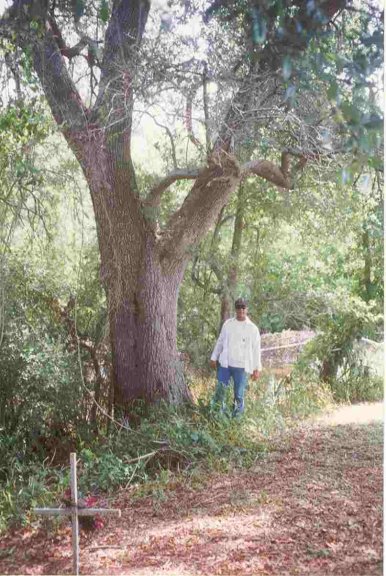
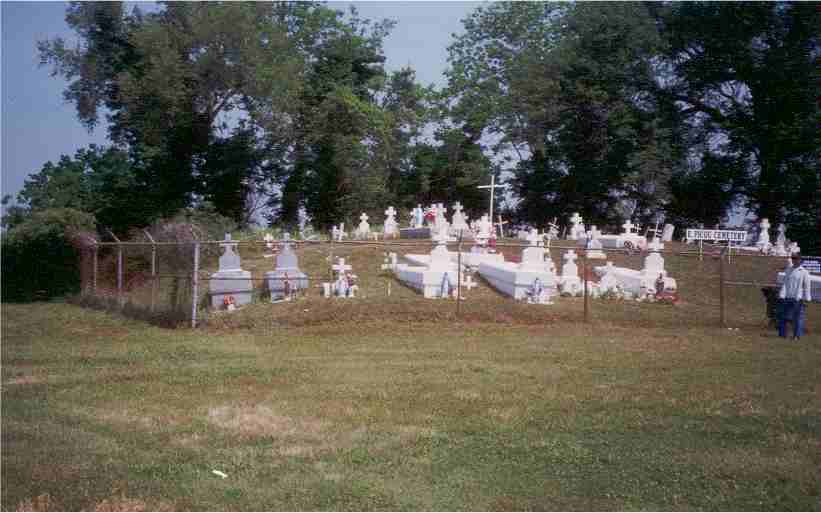
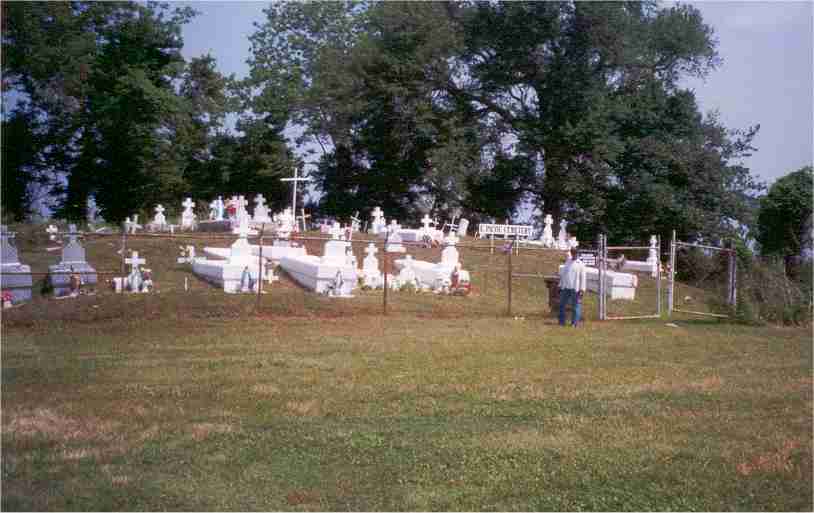
Picou Cemetery (Photos taken in Spring 1996)
After viewing picture use "Back" button to return
The
oak tree, above left, grows on the back side of the Indian Mound, now known as "E. Picou
Cemetery," on Bayou Little Caillou, just before Robinson Canal, in
Terrebonne Parish, LA. It is almost on the northwest corner of the mound and the
tallest tree there.
The mound shows two
levels; the first was about five feet above the local level of the ground and is
shown on old maps as Indian Mound. The tree grows from the first level of
the mound. The second level raises this mound about four feet higher and is now
a cemetery. Borrow pits from the excavated dirt that was used to build the mound
higher are clearly visible on the north and west sides of the cemetery.
In his book, The
Indians of Dulac, Edison Roy stated this was an old Indian graveyard. It was
first used by whites during a yellow fever epidemic to bury the victims. The
earliest date of death on a legible marker on this mound is 1890. Therefore, it
is assumed the yellow fever victims were buried in the first level of ground,
then the mound was built higher for its present use.
Indian lore has it
that when a chief was buried a tree was planted over his grave. In 1844 Houma
Courteau dit Tacalobé and Touh-la-baye, a Biloxi Indian, forefather of most of
the Indians in Terrebonne and Lafourche Parishes, owned and lived on this land,
raising cattle. He died in summer of that year, according to his probate. His
wife, Marie Anne [Pierre], an Acolapissa Indian, died the following year. This
tree is estimated to be over 100 years old, based on the size of its trunk. Is
this the tree planted in his memory? There is also a large old persimmon tree on
the opposite corner of the first level of this mound.
First Indian High School in the State of Louisiana at Daigleville
1.
 2.
2.
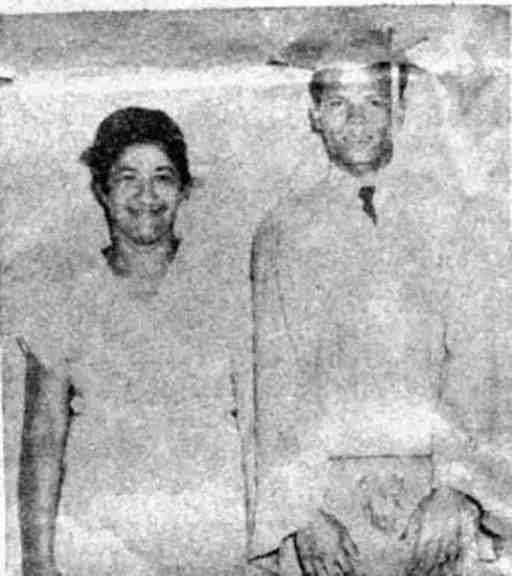
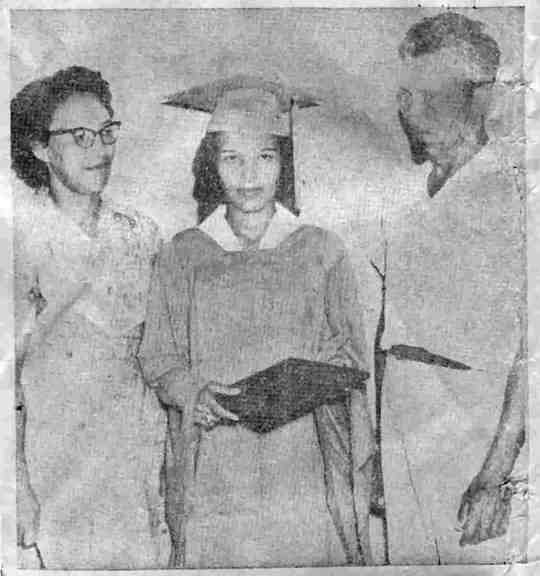
1. Rosalie Sanders 2.
Willis Billiot
After viewing pictures use "Back" button to return
At one time, Daigleville was a community outside, and to the south, of the city limits of Houma. It has since been incorporated into the city in recent date, along with public services and improvements for its residents. Among its residents were, and still are, descendants of the early Biloxi-Chitimacha-Choctaw people who settled in Terrebonne Parish, and it is still called "Daigleville" by many of the older folk. One of its claims to fame was the establishment of the first Indian High School in the state, in 1959. Before then, Indian children could only go through the eighth grade and were given a certificate for that amount of education. This completed their education because any higher schooling had to be out of state, which parents could not afford. Although, even in 1959, it was a state requirement that children could not "quit" school until they were sixteen years old, Indian children were the exception. Most eighth graders, then and now, are about thirteen or fourteen years old. Also, because no vocational training was available, the only employment available was the very lowest level, service work or jobs related to the fishing or shrimping industry. Many "graduates" could only find local employment peeling shrimp at the local processing plants, which practiced segregation - down to the rest rooms and water fountains they were allowed to use.
The first graduates from this Indian high school were Rosalie Sanders, George Billiot, Mildred Solet, Willis "Bill" Billiot, and Roy Adam Parfait, a total of five students. The Houma Courier newspaper of Friday, June 1, 1962, carried an account of the event in section 4, page 10, entitled "First Inhabitants of Dulac Graduated from High School." The sub-title declared Greenburg Says Excuse of Ages Lost Through Modern Education. " 'Je ne suis pas instruit' - his excuses for lack of knowledge has been lost by people of the Dulac community en (sic: in) the persons of the five smiling sons and daughters who were graduated in ceremonies from Daigleville Indian High School Monday night in the Dulac Community Center. So affirmed - partly in French, partly in English - guest speaker former District Attorney Leonard Greenburg who predicted that some day the center would be half filled with high school graduates from Dulac.
"By having proved their individual ability in successfully completing the state and parish requirement for a secondary school diploma, the graduates, said Greenburg, have lost the excuses of generations for years. He referred to the above and variant phrases either in French or English heard in his law office from those not privileged with an education.
"The speaker subsequently urged the quintet of high school graduates to become leaders in their community, reminding them that the smiles of satisfaction on their faces were most justifiable and that their diploma can now serve as a key to further education."
Willis Joseph Billiot was valedictorian of the graduating class. He had applied for, and received, a full scholarship for National College in Kansas City, Missouri. Following the theme of the motto of the graduating class, "Living is a gift of God; beautiful living is a gift of education," the address he gave began,
"God gives us life and puts the developing of our lives in our hands. Our life is whatever we make it. We ourselves develop ourselves. By our reactions to circumstances, we decide our character and our development. We take what is given to us and shape it. Life is most highly developed when educated."
Willis went on to National College for one year, also attended an Indian workshop in Boulder, Colorado for one summer, then transferred to Montith College in Detroit, Michigan, a branch of Wayne University where he went for four years. He then went to the University of California at Berkeley for four years. He majored in foreign languages, in particular the Russian language. While at the University of California, he was awarded a scholarship to study in Norway one summer, where he spent three months. Willis died in 1981 and was buried in Marrero, Louisiana.
Willis and Rosalie Sanders were married and have two children, a son and a daughter. Rosalie was the Office Administrator for the B.C.C.M. and lived in the old Daigleville community in Houma. She was employed by Bell South.
